PROJECT
THE PEEPAL CIRCLE
The Friendship Bench
Global Shapers Community
Challenge
India faces a severe mental health crisis, with over 80% of people who need care receiving none. The barriers are systemic: a shortage of mental health professionals, high costs, social stigma, and a lack of culturally relevant support systems. Traditional, top-down clinical models are not reaching the communities that need them most.
Opportunity
How might we make mental health support accessible, non-stigmatising, and embedded in everyday community life, especially for underserved populations? The Peepal Circle answers this by reimagining care not as a clinical transaction, but as a human conversation, in partnership with the Friendship Bench, upskilling community members to become trained listeners, into public spaces, making help visible, approachable, and rooted in trust.
What's in the name?
The Peepal tree, sacred across India, has long been a place where people gather to talk, rest, and reflect. It symbolizes healing, wisdom, and community. We chose it as the anchor for our name because it carries familiarity and trust. “Circle” adds the values of openness, equality, and shared space. Together, The Peepal Circle reframes mental health support as something human, local, and stigma-free. The name was a deliberate design decision to shift how care is seen and accessed.
A first friendship bench in India: The Peepal Circle
I first discovered the Friendship Bench model through YouTube’s algorithm, a talk by Dixon Chibanda, the man behind the idea, appeared in my feed. I was got inspired by his clarity, humility, and design-minded approach to mental health, so I started digging; watching more of his interviews, studying the model, and learning how they turned community listening into clinical impact. I also found that one of their team members was part of the Global Shapers network in Harare. So I wrote a proposal and reached out. Why Bangalore? Because while the city promises opportunity, the reality is more complex. Many who migrate here for work end up pushed to the outskirts, where housing is cheaper, but isolation, alcohol use and depression are rising. Karnataka has one of the highest suicide rates in India. If access is already difficult within the city, it’s nearly impossible in underserved areas. That’s where the idea to localise the Friendship Bench began.
Turning vision into motion
Once the project proposal, budget, and timeline were defined, I focused on building the right support. I reached out to WHO mental health professionals based in India, who agreed to mentor the Peepal Circle project. From the Global Shapers Bengaluru Hub I network, we regrouped into a core team and structured us into micro-teams of three for efficiency. We entered the phase 1 of the project with one group leading market research, identifying five underserved communities and conducting stakeholder interviews with experts, including from NIMHANS. The goal was to validate the need and spread early awareness. The other sub-team focused on fundraising and partnerships, initiating conversations with organisations like the WHO, the Zimbabwean Embassy in India, and potential local collaborators. It seemed at first hand to be a big project, but exciting to be able to have to opportunity to at least try.
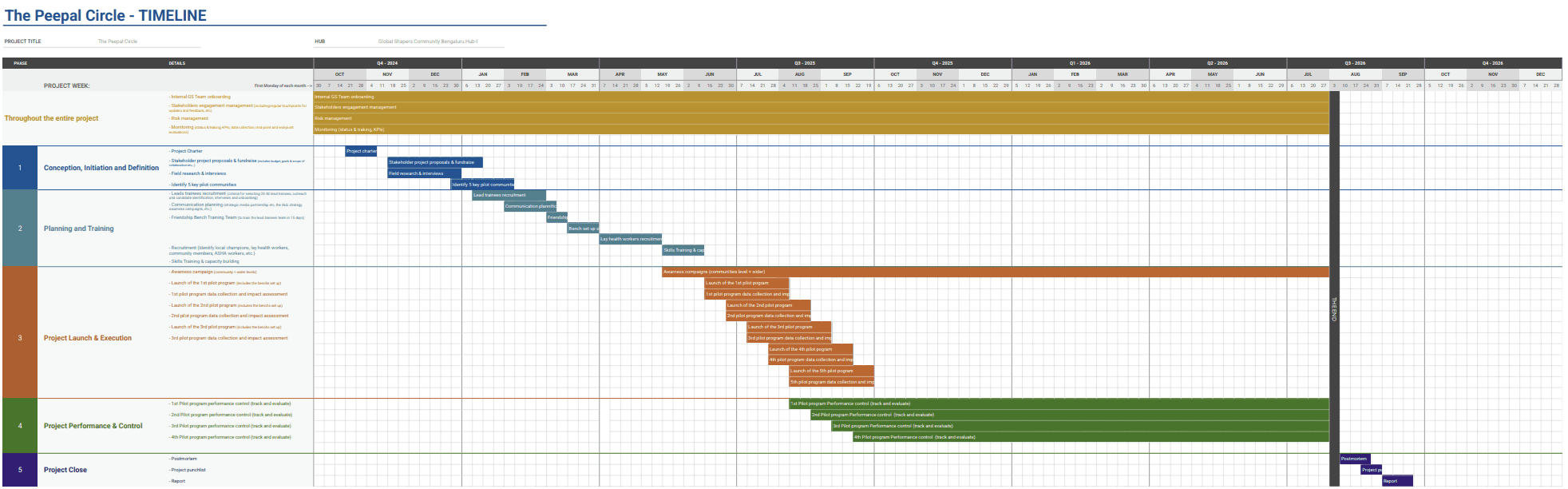
Adapting the model, a design thinking challenge
In Zimbabwe, Friendship Bench relies on grandmothers as lay counselors, trusted, respected figures in the community. But India is different. It's not just one country; it's a subcontinent of over 1.4 billion people, where language, religion, social norms, and even the role of elders shift drastically from state to state. Indian grandmothers don’t universally carry the same cultural authority, and in some contexts, they may even reinforce stigma. So we had to ask: Who, in these communities, carries trust? Who can offer a listening ear without judgment? This was a critical design question. Our goal wasn’t just to localise a program, it was also to reimagine who the healer could be. Once we identified underserved communities, our next challenge was to map trust networks and select the right people to be trained by the Friendship Bench team. These individuals wouldn’t just offer support, they’d become the carriers of knowledge and care within their own ecosystems.
The Benches
Benches - central to the original model - aren’t a common part of Bangalore’s urban or community infrastructure. Parks have
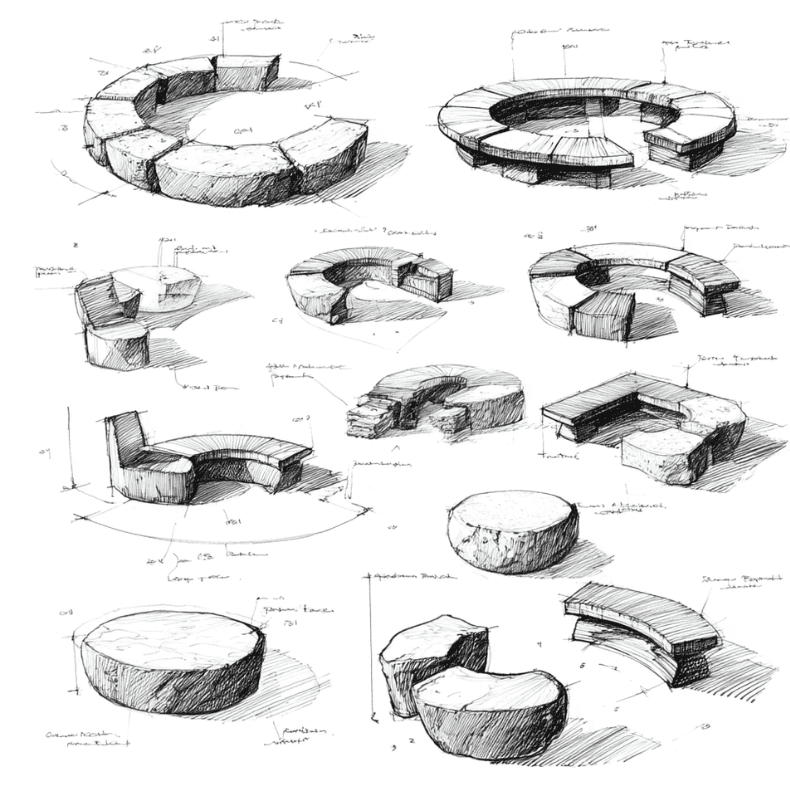
a few, but in most neighborhoods, especially underserved ones, they’re rare or nonexistent. We couldn’t just replicate the Zimbabwe model verbatim; we had to redesign the medium itself. What mattered wasn’t the bench itself, it was what the bench represented: a safe, informal space where people could talk comfortably. So the challenge became: What does a “bench” look like in Bangalore? I began exploring and sketching alternatives that could carry the same emotional function within the Indian context, cost-efficient, sustainable and...monsoon-safe.
Inspiration

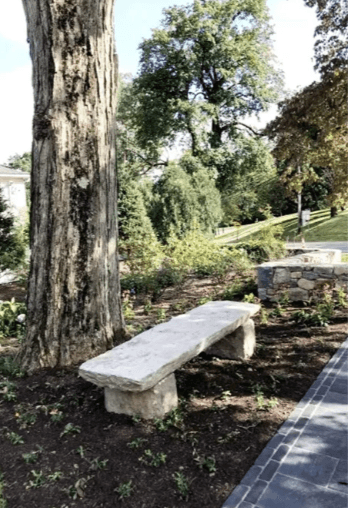


The Sketches
Where the Peepal Circle stands today
The Peepal Circle is currently paused. The pilot framework is built, partners identified, and research completed, but the team isn’t in place. What began as a collective initiative became a solo effort, and without shared ownership or operational infrastructure, execution stalled. I’ve preserved the foundation and remain committed to the concept. When the right team and structure align, it’s ready to activate. Until then, my focus is on building where ambition is met with accountability.
Lessons I have learned so far
Purpose alone can’t compensate for a lack of structure. Without clear roles, shared ownership, and built-in accountability, even the most mission-driven teams drift. I made the mistake of overfunctioning, chasing follow-through from people who had already signaled they weren’t invested. That’s not leadership; that’s misallocated energy.
Leadership, I’ve learned here, means designing for clarity, not assuming it. That means setting high standards, defining ownership, and building systems where initiative isn’t just possible, it’s expected. One moment made this painfully clear: during an interview to join the Global Shapers Hub, a candidate openly admitted he didn’t know what the initiative was, and then described his strongest trait as being a narcissist. He was hired anyway. That told me everything. When standards blur, mission dilutes.
I now ask better questions: Are we designing for shared responsibility? Are incentives and expectations aligned? Does the system reflect the standard we claim to uphold? Because if not, the mission doesn’t scale, it unravels.